10/02/2011

"But it was in Appalachia, in places like Patrick County, Virginia, where the ties between the chestnut and people were most tightly bound. 'If ever there was a place defined by a tree, it was Appalachia,' says folk historian Charlotte Ross, of Appalachian State University. The American chestnut 'was our icon. We loved that tree.'

"On the steep slopes and in the cool, moist hollows of the southern Appalachian mountains, chestnuts grew so abundantly that they accounted for as many as one in four forest trees, and in some places, even more. Chestnuts were big trees everywhere, but this land gave rise to giants – trees a dozen feet wide and ten times as tall. One Goliath in Francis Cove, North Carolina, measured seventeen feet across. In spring, the trees bloomed long bushy catkins of cream-colored flowers that filled the woods with a pungent perfume and made the forests look, from a distance, 'like a sea with white combers plowing across its surface,' as the naturalist Donal Culross Peattie wrote." (pages 17-18)

"No one needed to buy land to pasture cattle or hogs when the forests supplied such a wealth of forage. Farmers would simply notch their mark in the ears of their livestock and turn the animals loose to roam the woods until they were to be butchered or sold. A pig could grow stout as a barrel on chestnuts, acorns, and hickory nuts. That ample carpet of nuts, sometimes inches thick, allowed drovers to move huge herds of hogs, cattle, and even turkeys across the slopes of the southern mountains to supply food for laborers on the plantations to the Southeast. The wildlife that also feasted on the nuts ensured a steady supply of game for the dinner table. 'There wasn't no kind of game that roamed these mountains that didn't eat the chestnuts,' Georgia native Jake Waldroop recalled.' The chestnuts supported everything.

"Folklorist Ross believes the chestnut not only supported settlement in the Appalachians but invited it. The early Scots-Irish settlers wrote letters home describing the riches the woods offered. 'The chestnut mast is knee-deep,' one man boasted, referring to the heavy accumulation of nuts. 'C'mon over cousin,' another wrote to his family in Ulster, Ireland. 'This is the best poor man's country.' And their countrymen followed. Over time the mountains filled with enclaves of tough, independent-minded people who were used to wrestling a living out of the poorest farmland." (pages 19- 20)

From American Chestnut: The Life, Death, and Rebirth of a Perfect Tree by Susan Freinkel

9/09/2011

"He only saw the river, shimmering reddish yellow, and bounded into it with his shoes and his coat on and took a gulp. He swallowed some and spit the rest out and then he stood there in water up to his chest and looked around him. The sky was a clear pale blue, all in one piece—except for the hole the sun made—and fringed around the bottom with treetops. His coat floated to the surface and surrounded him like a strange gay lily pad and he stood grinning in the sun. He intended not to fool with preachers any more but to Baptize himself and to keep on going this time until he found the Kingdom of Christ in the river. He didn’t mean to waste any more time. He put his head under the water at once and pushed forward.

"In a second he began to gasp and sputter and his head reappeared on the surface; he started under again and the same thing happened. The river wouldn’t have him. He tried again and came up, choking. This was the way it had been when the preacher held him under—he had had to fight with something that pushed him back in the face. He stopped and thought suddenly: it’s another joke, it’s just another joke! He thought how far he had come for nothing and he began to hit and splash and kick the filthy river. His feet were already treading on nothing. He gave one low cry of pain and indignation. Then he heard a shout and turned his head and saw something like a giant pig bounding after him, shaking a red and white club and shouting. He plunged under once and this time, the waiting current caught him like a long gentle hand and pulled him swiftly forward and down. For an instant he was overcome with surprise: then since he was moving quickly and knew that he was getting somewhere, all his fury and fear left him."

From "The River" by Flannery O'Connor

8/29/2011

Some sequences:

Alec Soth's Broken Manual
Anna Shteynshleger's City of Destiny
Barry Stone's I Met a Unicorn
Danielle Mericle's Archive
Ed Panar's Walking Home
Karianne Bueno's Asper
Ron Jude's Other Nature

8/27/2011


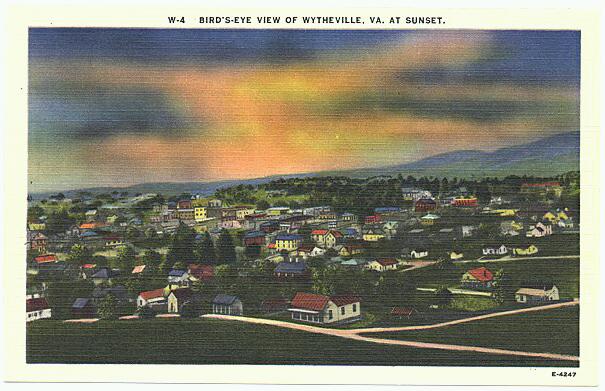
My great-great-grandfather Owens built this hotel in Wytheville, and my dad lived in the house behind it. Now there's a Stellar One bank there. More old postcards here.


8/23/2011


 Couple more rolls from the creek. Thanks, Emmanuel, for advice on processing!

8/22/2011

I commandeered my parents' upstairs bathroom and developed my first roll of color film last night! The highlights are blown out which is a little tragic, but it feels great to be working with objects again. Can't wait to get back to Akadem and order some cheap prints.

This was taken at Reed Creek.


8/16/2011

Hymn
A. R. Ammons

I know if I find you I will have to leave the earth
and go on out
   over the sea marshes and the brant in bays
and over the hills of tall hickory
and over the crater lakes and canyons
and on up through the spheres of diminishing air
past the blackset noctilucent clouds
   where one wants to stop and look
way past all the light diffusions and bombardments
up farther than the loss of sight
   into the unseasonal undifferentiated empty stark

And I know if I find you I will have to stay with the earth
inspecting with thin tools and ground eyes
trusting the microvilli sporangia and simplest
   coelenterates
and praying for a nerve cell
with all the soul of my chemical reactions
and going right on down where the eye sees only traces

You are everywhere partial and entire
You are on the inside of everything and on the outside

I walk down the path down the hill where the sweetgum
has begun to ooze spring sap at the cut
and I see how the bark cracks and winds like no other bark
chasmal to my ant-soul running up and down
and if I find you I must go out deep into your
   far resolutions
and if I find you I must stay here with the separate leaves

8/08/2011


Rock Carved by Drifting Sand, Below Fortification Rock, Arizona. Timothy O'Sullivan, 1871. (Here.)

7/24/2011

7/17/2011


Chris Verene, My Twin Cousin's Husband's Brother's Cousin's Cousins, 2003


Chris Verene, Mercedes Will Soon Have a Half-Sister Named Lexus, 2005


Chris Verene, The Same Day They Signed the Divorce Papers a Tornado Hit the House, 2007


Chris Verene, Rosie Meeting Elanor and Doris, 2001

Chris Verene has been making documentary photographs about his family's rural Illinois hometown of Galesburg for the past two decades. There's an interview here.

Edit: I got to see his book at Look3 in 2013, and it was the funniest, most heartbreaking, most full-of-ordinary-life photo book I've ever held in my hands.

7/04/2011

7/01/2011

Got curious about where Reed Creek starts. These are as close as I could get to the sources of its tributaries by following it on Google Maps. Get to a certain point and you can't tell the difference between a stream and a trail, or a change in elevation, or the shadows of trees. Guess there's only two ways to find out where the real headwaters are...!


And here's where it empties into New River:

6/13/2011

The City Limits
A. R. Ammons

When you consider the radiance, that it does not withhold
itself but pours its abundance without selection into every
nook and cranny not overhung or hidden; when you consider

that birds' bones make no awful noise against the light but
lie low in the light as in a high testimony; when you consider
the radiance, that it will look into the guiltiest

swervings of the weaving heart and bear itself upon them,
not flinching into disguise or darkening; when you consider
the abundance of such resource as illuminates the glow-blue

bodies and gold-skeined wings of flies swarming the dumped
guts of a natural slaughter or the coil of shit and in no
way winces from its storms of generosity; when you consider

that air or vacuum, snow or shale, squid or wolf, rose or lichen,
each is accepted into as much light as it will take, then
the heart moves roomier, the man stands and looks about, the

leaf does not increase itself above the grass, and the dark
work of the deepest cells is of a tune with May bushes
and fear lit by the breadth of such calmly turns to praise.
"Though these essays were written for a variety of occasions, they have a recurring subject – the effort we all make, photographers and nonphotographers, to affirm life without lying about it. And then to behave in accord with our vision."

From the foreword of Robert Adams' book Why People Photograph.

5/29/2011

"Most high, all powerful, all good Lord!
All praise is yours, all glory, all honor, and all blessing.

To you, alone, Most High, do they belong.
No mortal lips are worthy to pronounce your name.

Be praised, my Lord, through all your creatures,
especially through my lord Brother Sun,
who brings the day; and you give light through him.
And he is beautiful and radiant in all his splendor!
Of you, Most High, he bears the likeness.

Be praised, my Lord, through Sister Moon and the stars;
in the heavens you have made them bright, precious and beautiful.

Be praised, my Lord, through Brothers Wind and Air,
and clouds and storms, and all the weather,
through which you give your creatures sustenance.

Be praised, my Lord, through Sister Water;
she is very useful, and humble, and precious, and pure.

Be praised, my Lord, through Brother Fire,
through whom you brighten the night.
He is beautiful and cheerful, and powerful and strong.

Be praised, my Lord, through our sister Mother Earth,
who feeds us and rules us,
and produces various fruits with colored flowers and herbs.

Be praised, my Lord, through those who forgive for love of you;
through those who endure sickness and trial.

Happy those who endure in peace,
for by you, Most High, they will be crowned.

Be praised, my Lord, through our Sister Bodily Death,
from whose embrace no living person can escape.
Woe to those who die in mortal sin!
Happy those she finds doing your most holy will.
The second death can do no harm to them.

Praise and bless my Lord, and give thanks,
and serve him with great humility."

English translation of The Canticle of the Sun by Saint Francis of Assisi.

5/28/2011


The back yard of my dad's childhood home, just down the road.


The front yard, before and after Lee Highway (our stretch of Wilderness Road) was expanded.

From the scrapbooks of Mae Slater, my great-grandmother.

5/26/2011

"We learn a place and how to visualize spatial relationships, as children, on foot and with imagination. Place and the scale of space must be measured against our bodies and their capabilities. A 'mile' was originally a Roman measure of one thousand paces. Automobile and airplane travel teaches us little that we can easily translate into a perception of space. To know that it takes six months to walk across Turtle Island/North America walking steadily but comfortably all day every day is to get some grasp of the distance. [...] I think many of us would consider it quite marvelous if we could set out on foot again, with a little inn or a clean camp available every ten or so miles and no threat from traffic, to travel across a large landscape – all of China, all of Europe. That's the way to see the world: in our own bodies." (pg. 98-99)

From "Blue Mountains Constantly Walking" by Gary Snyder in The Practice of the Wild.

5/24/2011


I'm giving these fellas away for summer safekeeping. Hope they survive until August!

5/20/2011

"It took me some years to realize it, but I have taken my unspectacular style of skateboarding with me into my photographic approach. I was always happier with a long, smooth tail-slide than with a flailing, spinning 360. Just as now I am happier with photographs that carry me along for a while than with those that jump out and scream for attention. When I dream of skateboarding, I’m Mike McGill. When I dream of photographing, I’m Robert Adams."

Andrew Phelps in his photo-book 720 (Two Times Around).
"Throughout the world the original inhabitants of desert, jungle, and forest are facing relentless waves of incursions into their remotest territories. These lands, whether by treaty or by default, were left in their use because the dominant society thought the arctic tundra or arid desert or jungle forest ‘no good.’ Native people everywhere are now conducting an underprivileged and underfunded fight against unimaginably wealthy corporations to resist logging or oil exploration or uranium mining on their own land. They persist in these struggles not just because it has always been their home, but also because some places in it are sacred to them. This last aspect makes them struggle desperately to resist the powerful temptation to sell out – to take cash and accept relocation. And sometimes the temptations and confusion are too great, and they do surrender and leave."(pg. 80)

"We were traveling by truck over dirt track west from Alice Springs in the company of a Pintubi elder named Jimmy Tjungurrayi. As we rolled along the dusty road, sitting back in the bed of a pickup, he began to speak very rapidly to me. He was talking about a mountain over there, telling me a story about some wallabies that came to that mountain in the dreamtime and got into some kind of mischief with some lizard girls. He had hardly finished that and he started in on another story about another hill over here and another story over there. I couldn’t keep up. I realized after about half an hour of this that these were tales to be told while walking, and that I was experiencing a speeded-up version of what might be leisurely told over several days of foot travel. Mr. Tjungurrayi felt graciously compelled to share a body of lore with me by virtue of the simple fact that I was there.

"So remember a time when you journeyed on foot over hundreds of miles, walking fast and often traveling at night, traveling night-long and napping in the acacia shade during the day, and these stories were told to you as you went. In your travels with an older person you were given a map you could memorize, full of lore and song, and also practical information. Off by yourself you could sing those songs to bring yourself back. And you could maybe travel to a place that you’d never been, steering only by songs you had learned." (pg. 82-83)

"One day driving near Ilpili we stopped the truck and Jimmy and the three other elderly gentlemen got out and said, 'We’ll take you to see a sacred place here. I guess you’re old enough.' They turned to the boys and told them to stay behind. As we climbed the bedrock hill these ordinarily cheery and loud-talking aboriginal men began to drop their voices. As we got higher up they were speaking whispers and their whole manner changed. One said almost inaudibly, 'Now we are coming close.' Then they got on their hands and knees and crawled. We crawled up the last two hundred feet, then over a little rise into a small basin of broken and oddly shaped rocks. They whispered to us with respect and awe of what was there. Then we all backed away. We got back down the hill and at a certain point stood and walked. At another point voices rose. Back at the truck, everybody was talking loud again and no more mention was made of the sacred place.” (pg. 83-84)

"This sacredness implies a sense of optimal habitat for certain kinfolk that we have out there – the wallabies, red kangaroo, bush turkeys, lizards. Geoffrey Blainey (1976, 202) says, ‘The land itself was their chapel and their shrines were hills and creeks and their religious relics were animals, plants, and birds. Thus the migrations of aboriginals, though spurred by economic need, were also always pilgrimages.’ Good (productive of much life), wild (naturally), and sacred were one." (pg. 85)

All from Gary Snyder's essay "Good, Wild, Sacred" in The Practice of the Wild.

5/15/2011


Осины и берёзы.

5/10/2011

5/09/2011


William Christenberry, Kudzu and House, Tuscaloosa County, AL 1979


William Christenberry, Kudzu and House, Tuscaloosa County, AL 1987


William Christenberry, Kudzu and House, Tuscaloosa County, AL 1988


William Christenberry, Kudzu and House, Tuscaloosa County, AL 1990


William Christenberry, Kudzu and House, Tuscaloosa County, AL 1991


William Christenberry, Site of Kudzu and House, Tuscaloosa County, AL 1992

"This is and always will be where my heart is. It is what I care about. Everything I want to say through my work comes out of my feelings about that place--its positive aspects and its negative aspects. It's one of the poorest counties in the state, but it is also a county with great lore and legend. In the nineteenth century it must have been like Gone With the Wind, a place with great southern plantations. It became clear to me during my graduate studies [1958-59, at the University of Alabama at Tuscaloosa] that I wanted to express my feelings about this place. To paraphrase William Faulkner, 'There is enough to write about on this little stamp-sized state called Mississippi to occupy me all of my life.'"

"Unlike Agee, Walker kept his distance emotionally. His view was objective. My stance is very subjective. The place is so much a part of me. I can't escape it and have no desire to escape it. I continue to come to grips with it. I don't want my work to be thought of as maudlin or overly sentimental. It's not. It's a love affair--a lifetime of involvement with a place. The place is my muse."

"Although my work is largely celebratory there is this dark side that permeates the South. How could I avoid the issues of the civil rights period and the terrible evil that manifests itself in the Ku Klux Klan (KKK)? I have often doubted whether or not I would live long enough to see the progress that the Deep South has made in civil rights, but there is still much to be done.

"Just a few weeks after my arrival in Memphis in 1962, James Meredith attempted to integrate the University of Mississippi, which is only sixty miles south of Memphis. In a way, Memphis is the big city of Mississippi. I was listening on the radio to the broadcast of that event. Two people were killed that night down in Oxford, Mississippi. How could I as a human being, forget being a Southerner, let that go by me? I've never been a marcher or a joiner, it's just not my nature, and sometimes I've regretted that. The only thing that I participated in along that line was the 1968 Memphis Sanitation Workers' March just before Dr. Martin Luther King Jr. was killed."

Photos from the Museum of Contemporary Photography. More work at Pace/MacGill. Interview from Light Reseach via ASX.

5/08/2011

5/06/2011

"There are two ways of looking at a thing. Either you feel that a thing must be perfect before you present it to the public, or you are willing to let it go out even knowing that it is not perfect, because you are striving for something even beyond what you have achieved, but in struggling too hard for perfection you know that you may lose the very glimmer of life, the very spirit of the thing that you also know exists at a particular point in what you have done; and to interfere with it would be to destroy that very living quality.

"I am myself always in favor of practicing in public. There are, of course, those people who say, 'But the public is not interested in watching people practice. It wants the finished thing or nothing.' My answer is that if one does not practice in public in reality, then in nine cases out of ten the world will never see the finished product of one's work. Some people go on the assumption that if a thing is not a hundred per cent perfect it should not be given to the world, but I have seen too many things that were a hundred per cent perfect that were spiritually dead, and then things that have been seemingly incomplete that have life and vitality, which I prefer by far to the other so-called perfect thing.

"It is one thing to think about a piece of work as a scientific or objective entity that will stand up a hundred years hence, and another to think of the living quality of the person doing the thing and of his development. Is the thing felt – does it come out of an inner need – an inner must? Is one ready to die for it? ...that is the only test."

Alfred Steiglitz, quoted by Dorothy Norman in America and Alfred Steiglitz, pages 136-137, and re-quoted by Jennilee Marigomen here.


Plant identifier for the Novosibirsk Oblast' – best present ever????

5/02/2011

"Thoreau in the 1840s took comfort in being able to escape even what he sensed were the noisy intrusions in small towns. In his essay 'Walking,' he celebrated the fact that he could 'easily walk ten, fifteen, twenty, any number of miles, commencing at my door, without going by any house.' He wondered 'what would become of us if we walked only to a garden or a mall?' He was innocent, of course, of the degree to which the question would be forced, of the fact that eventually no one would be able to find one square mile in America free of the imprint of man."

"As Henry Beetle Hough, the late editor of the Vineyard Gazette, said not long before he died, he was sorrier about the destruction of Martha's Vineyard than about the apparent fate of the world. We feel worst about losing the specifics of home. The issue is not just that land developers have unbalanced the ecology and made much of the geography ugly. What strikes so painfully is that, at least in the perspective of our brief lives, they have destroyed the places where we became, and would like to continue to become, ourselves."

"I take comfort ... in hope for a change not requiring large sums of money, and for the most part not in need of a majority vote – a reshaping that will come about, I think, as the result of the needs and the efforts of individuals: a recognition and enrichment and preservation over the centuries of specifically sacred places. The final goal will remain that all places be recognized as holy, but, as a step of the way, locations of particular intensity will more and more be held dear."

"Someday not only will there be more places that encourage a harmony with nature, but there will be, I think, new sacred sites originating in the principal religious traditions of our culture, Judaism and Christianity, the correction of which seems to me imperative because their abandonment is impossible (one cannot walk away form the center of one's culture and survive; Judaism and Christianity embody insights that are unique and, at least in my experience, true)."

"Many times and places since then I have tried to photograph the quality in that scene, having slowly been brought to realize that however much I loved what I saw of western American wilderness, to have loved it raw best, lifelong, would have required a misanthropy that I couldn't have borne. Like many, I have come to hope to find a valley, in sight of peaks but gentler than they are, and to be permitted to make the valley even more itself, better consonant with a harmony in nature that seems finally more true than nature's violence. To try to do this is, I know, in consideration of our history, to embark on another failure, but I believe that our weakness is at least understood, and that we may hope to be forgiven."

"America was not settled only by those following a dream of profit. Just as often, our forebears' motive was to escape some nightmare of hunger or stultification or violence, and they would always love, with a sudden intensity against which they could never fully guard themselves, the geography where they were raised – the flowers, trees, birds, clouds, and lay of the land. Ours has never been, really, just a country of easygoing transients. There has always been a counter tradition of learning to make the best of exile, of building from recollections of what was prized and torn away."

Fragments of "In the American West Is Hope Possible?" a killer essay by Robert Adams, 1986