When the Ob River was dammed up in the 1950s to build the Berdsk Reservoir, much of the old city of Berdsk was submerged, and some villages, too. I've been working in Berdsk this year! Here are some maps. I found the first one here.
4/04/2012
3/20/2012
I like Kevin Anchukaitis's posts on the NYTimes Scientist at Work blog about studying Guatemala's climate history through tree rings! Here's the first one.
"Andrew E. Douglass, the astronomer who founded dendrochronology, wrote, 'Through long ages past and with unbroken regularity, trees have jotted down a record at the close of each fading year — a memorandum as to how they passed the time.'"
3/12/2012
John James Audubon, Great-footed Hawk
John James Audubon, Wild Turkey
John James Audubon, Spotted Grous
From The Birds of America, 1827-1838. Lots more here.
2/21/2012
"Man is best defined not as a 'logical' but as a 'eucharistic' animal. He does not merely live in the world, think about it and use it, but he is capable of seeing the world as God's gift, as a sacrament of God's presence and a means of communion with him. So he is able to offer the world back to God in thanksgiving. 'Thine own from thine own we offer to thee, in all and for all' (The Liturgy of St John Chrysostom).
"Secondly, besides blessing and praising God for the world, man is also able to reshape and alter the world, and so to endue it with fresh meaning. In the worlds of Fr Dumitru Staniloae, 'Man puts the seal of his understanding and of his intelligent work onto creation...The world is not only a gift, but a task for man.' It is our calling to co-operate with God; we are, in St Paul's phrase, 'fellow-workers with God' (1 Cor. 3:9). Man is not just a logical and eucharistic animal, but he is also a creative animal: the fact that man is in God's image means that man is a creator after the image of God the Creator. This creative role he fulfills, not by brute force, but through the clarity of his spiritual vision; his vocation is not to dominate and exploit nature, but to transfigure and hallow it.
"In a variety of ways–through the cultivation of the earth, through craftsmanship, through the writing of books and the painting of ikons–man gives material things a voice and renders the creation articulate in praise of God. It is significant that the first task of the newly-created Adam was to give names to the animals (Gen. 2:19-20). The giving of names is in itself a creative act: until we have find a name for some object or experience, an 'inevitable word' to indicate its true character, we cannot begin to understand it and to make use of it. It is likewise significant that, when at the Eucharist we offer back to God the firstfruits of the earth, we offer them not in their original form but reshaped by the hand of man: we bring to the altar not sheaves of wheat but loaves of bread, not grapes but wine."
The Orthodox Way by Bishop Kallistos Ware (pages 53-54)
"Secondly, besides blessing and praising God for the world, man is also able to reshape and alter the world, and so to endue it with fresh meaning. In the worlds of Fr Dumitru Staniloae, 'Man puts the seal of his understanding and of his intelligent work onto creation...The world is not only a gift, but a task for man.' It is our calling to co-operate with God; we are, in St Paul's phrase, 'fellow-workers with God' (1 Cor. 3:9). Man is not just a logical and eucharistic animal, but he is also a creative animal: the fact that man is in God's image means that man is a creator after the image of God the Creator. This creative role he fulfills, not by brute force, but through the clarity of his spiritual vision; his vocation is not to dominate and exploit nature, but to transfigure and hallow it.
"In a variety of ways–through the cultivation of the earth, through craftsmanship, through the writing of books and the painting of ikons–man gives material things a voice and renders the creation articulate in praise of God. It is significant that the first task of the newly-created Adam was to give names to the animals (Gen. 2:19-20). The giving of names is in itself a creative act: until we have find a name for some object or experience, an 'inevitable word' to indicate its true character, we cannot begin to understand it and to make use of it. It is likewise significant that, when at the Eucharist we offer back to God the firstfruits of the earth, we offer them not in their original form but reshaped by the hand of man: we bring to the altar not sheaves of wheat but loaves of bread, not grapes but wine."
The Orthodox Way by Bishop Kallistos Ware (pages 53-54)
2/20/2012
11/26/2011
"What are the consequences of imposing human values on the natural world? The blight may seem evil to us, but the from the vantage point of the fungus, that other parasite we await might be considered equally evil.
"Perhaps, Frost is ultimately reminding us, our tendency to view nature in terms of our notions of good and bad, desirable and undesirable, can wreak its own kind of evil. Certainly the American chestnut would never have been pushed to the brink of extinction were it not for human agency. Humans introduced the chestnut blight. The tree's plight is a direct result of our visions of what our gardens, our personal Edens, should contain. It's a lesson to bear in mind as we press forward in efforts to redress the blight and restore our perfect tree." (page 128)
"Unfortunately, it's easy to overlook the change. Diseases and insects spread slowly. The losses they produce accumulate over time, without any obvious beginning or end. By the time the chestnut forests were gone, there were whole new generations who didn't know anything was missing. 'One of the penalties of an ecological education is that one lives alone in a world of wounds,' Leopold wrote. But in an era when there's talk of a widespread 'nature deficit disorder', how many of us have the expertise to recognize the wounds that are being inflicted? It's easy for someone like me, a city dweller with an untrained eye, to look out over a forest vista – as I did in Patrick County, Virginia – and naïvely be reassured by the rolling waves of green. That took place early in my research for this book, and at the time, I did not yet understand that the scene I was admiring was far from a picture of health. In just one example of the troubles now plaguing the southern Appalachian woods, the oak trees that filled the chestnut's place in the forests are themselves in the midst of a major die-back caused by a complicated disease complex known as oak decline. And as those oaks die, they are being replaced by trees like red maple that have even less value to wildlife. As one forest ecologist told me, 'When you have tree species after tree species disappearing, what worries me is there will still be trees and shrubs and people will think their forests are beautiful. But to those who knew what the forest once looked like, it will look like the ruins of an ancient civilization." (page 224)
From American Chestnut: The Life, Death, and Rebirth of a Perfect Tree by Susan Freinkel
"Perhaps, Frost is ultimately reminding us, our tendency to view nature in terms of our notions of good and bad, desirable and undesirable, can wreak its own kind of evil. Certainly the American chestnut would never have been pushed to the brink of extinction were it not for human agency. Humans introduced the chestnut blight. The tree's plight is a direct result of our visions of what our gardens, our personal Edens, should contain. It's a lesson to bear in mind as we press forward in efforts to redress the blight and restore our perfect tree." (page 128)
"Unfortunately, it's easy to overlook the change. Diseases and insects spread slowly. The losses they produce accumulate over time, without any obvious beginning or end. By the time the chestnut forests were gone, there were whole new generations who didn't know anything was missing. 'One of the penalties of an ecological education is that one lives alone in a world of wounds,' Leopold wrote. But in an era when there's talk of a widespread 'nature deficit disorder', how many of us have the expertise to recognize the wounds that are being inflicted? It's easy for someone like me, a city dweller with an untrained eye, to look out over a forest vista – as I did in Patrick County, Virginia – and naïvely be reassured by the rolling waves of green. That took place early in my research for this book, and at the time, I did not yet understand that the scene I was admiring was far from a picture of health. In just one example of the troubles now plaguing the southern Appalachian woods, the oak trees that filled the chestnut's place in the forests are themselves in the midst of a major die-back caused by a complicated disease complex known as oak decline. And as those oaks die, they are being replaced by trees like red maple that have even less value to wildlife. As one forest ecologist told me, 'When you have tree species after tree species disappearing, what worries me is there will still be trees and shrubs and people will think their forests are beautiful. But to those who knew what the forest once looked like, it will look like the ruins of an ancient civilization." (page 224)
From American Chestnut: The Life, Death, and Rebirth of a Perfect Tree by Susan Freinkel
11/21/2011
Shows like this make me excited to be alive!
The Great American Hall of Wonders at the Smithsonian American Art Museum
Seeing Is Knowing: The Universe at Carleton College's Perlman Teaching Museum
In the Company of Animals at The Morgan Library & Museum
The Great American Hall of Wonders at the Smithsonian American Art Museum
Seeing Is Knowing: The Universe at Carleton College's Perlman Teaching Museum
In the Company of Animals at The Morgan Library & Museum
11/06/2011
Remember my apple trees? A couple got nibbled by a cat, but the rest look happy thanks to Svyeta!
"You planted them, I watered them, and God grew them," she said.
11/04/2011
"Despite the repeated setbacks, Graves's enthusiasm for the project never faltered. Year after year, he filed dispatches from the field reporting on another hybrid 'new to science'. He'd describe each in lovingly rich language that reflected his appreciation for nature's stupendously varied palette. The Essate-Jap was 'reddish to Kaiser brown'. The Kelsey had 'burnt sienna bark' and twigs of 'light mineral grey'. The young Hamden's bark was a tint 'somewhere between buckthorn brown and Dresden brown'.
"'He never had a shadow of a doubt about the fact that he was going to bring back the chestnut,' recalled Richard Jayes . . ."
pages 99-100 of American Chestnut by Susan Freinkel
"'He never had a shadow of a doubt about the fact that he was going to bring back the chestnut,' recalled Richard Jayes . . ."
pages 99-100 of American Chestnut by Susan Freinkel
11/02/2011
10/13/2011
Hi, I just wanted to show that I have been taking pictures this summer and fall, but I don't have the money to develop these babies right now!
I'm leaving for Russia in a week. But I'm not letting Photoland touch my film again, so I probably won't develop any pictures I take there until I get back, either. So...get ready for this blog to explode come August.
10/02/2011
"But it was in Appalachia, in places like Patrick County, Virginia, where the ties between the chestnut and people were most tightly bound. 'If ever there was a place defined by a tree, it was Appalachia,' says folk historian Charlotte Ross, of Appalachian State University. The American chestnut 'was our icon. We loved that tree.'
"On the steep slopes and in the cool, moist hollows of the southern Appalachian mountains, chestnuts grew so abundantly that they accounted for as many as one in four forest trees, and in some places, even more. Chestnuts were big trees everywhere, but this land gave rise to giants – trees a dozen feet wide and ten times as tall. One Goliath in Francis Cove, North Carolina, measured seventeen feet across. In spring, the trees bloomed long bushy catkins of cream-colored flowers that filled the woods with a pungent perfume and made the forests look, from a distance, 'like a sea with white combers plowing across its surface,' as the naturalist Donal Culross Peattie wrote." (pages 17-18)
"No one needed to buy land to pasture cattle or hogs when the forests supplied such a wealth of forage. Farmers would simply notch their mark in the ears of their livestock and turn the animals loose to roam the woods until they were to be butchered or sold. A pig could grow stout as a barrel on chestnuts, acorns, and hickory nuts. That ample carpet of nuts, sometimes inches thick, allowed drovers to move huge herds of hogs, cattle, and even turkeys across the slopes of the southern mountains to supply food for laborers on the plantations to the Southeast. The wildlife that also feasted on the nuts ensured a steady supply of game for the dinner table. 'There wasn't no kind of game that roamed these mountains that didn't eat the chestnuts,' Georgia native Jake Waldroop recalled.' The chestnuts supported everything.
"Folklorist Ross believes the chestnut not only supported settlement in the Appalachians but invited it. The early Scots-Irish settlers wrote letters home describing the riches the woods offered. 'The chestnut mast is knee-deep,' one man boasted, referring to the heavy accumulation of nuts. 'C'mon over cousin,' another wrote to his family in Ulster, Ireland. 'This is the best poor man's country.' And their countrymen followed. Over time the mountains filled with enclaves of tough, independent-minded people who were used to wrestling a living out of the poorest farmland." (pages 19- 20)
From American Chestnut: The Life, Death, and Rebirth of a Perfect Tree by Susan Freinkel
"On the steep slopes and in the cool, moist hollows of the southern Appalachian mountains, chestnuts grew so abundantly that they accounted for as many as one in four forest trees, and in some places, even more. Chestnuts were big trees everywhere, but this land gave rise to giants – trees a dozen feet wide and ten times as tall. One Goliath in Francis Cove, North Carolina, measured seventeen feet across. In spring, the trees bloomed long bushy catkins of cream-colored flowers that filled the woods with a pungent perfume and made the forests look, from a distance, 'like a sea with white combers plowing across its surface,' as the naturalist Donal Culross Peattie wrote." (pages 17-18)
"No one needed to buy land to pasture cattle or hogs when the forests supplied such a wealth of forage. Farmers would simply notch their mark in the ears of their livestock and turn the animals loose to roam the woods until they were to be butchered or sold. A pig could grow stout as a barrel on chestnuts, acorns, and hickory nuts. That ample carpet of nuts, sometimes inches thick, allowed drovers to move huge herds of hogs, cattle, and even turkeys across the slopes of the southern mountains to supply food for laborers on the plantations to the Southeast. The wildlife that also feasted on the nuts ensured a steady supply of game for the dinner table. 'There wasn't no kind of game that roamed these mountains that didn't eat the chestnuts,' Georgia native Jake Waldroop recalled.' The chestnuts supported everything.
"Folklorist Ross believes the chestnut not only supported settlement in the Appalachians but invited it. The early Scots-Irish settlers wrote letters home describing the riches the woods offered. 'The chestnut mast is knee-deep,' one man boasted, referring to the heavy accumulation of nuts. 'C'mon over cousin,' another wrote to his family in Ulster, Ireland. 'This is the best poor man's country.' And their countrymen followed. Over time the mountains filled with enclaves of tough, independent-minded people who were used to wrestling a living out of the poorest farmland." (pages 19- 20)
From American Chestnut: The Life, Death, and Rebirth of a Perfect Tree by Susan Freinkel
9/09/2011
"He only saw the river, shimmering reddish yellow, and bounded into it with his shoes and his coat on and took a gulp. He swallowed some and spit the rest out and then he stood there in water up to his chest and looked around him. The sky was a clear pale blue, all in one piece—except for the hole the sun made—and fringed around the bottom with treetops. His coat floated to the surface and surrounded him like a strange gay lily pad and he stood grinning in the sun. He intended not to fool with preachers any more but to Baptize himself and to keep on going this time until he found the Kingdom of Christ in the river. He didn’t mean to waste any more time. He put his head under the water at once and pushed forward.
"In a second he began to gasp and sputter and his head reappeared on the surface; he started under again and the same thing happened. The river wouldn’t have him. He tried again and came up, choking. This was the way it had been when the preacher held him under—he had had to fight with something that pushed him back in the face. He stopped and thought suddenly: it’s another joke, it’s just another joke! He thought how far he had come for nothing and he began to hit and splash and kick the filthy river. His feet were already treading on nothing. He gave one low cry of pain and indignation. Then he heard a shout and turned his head and saw something like a giant pig bounding after him, shaking a red and white club and shouting. He plunged under once and this time, the waiting current caught him like a long gentle hand and pulled him swiftly forward and down. For an instant he was overcome with surprise: then since he was moving quickly and knew that he was getting somewhere, all his fury and fear left him."
From "The River" by Flannery O'Connor
"In a second he began to gasp and sputter and his head reappeared on the surface; he started under again and the same thing happened. The river wouldn’t have him. He tried again and came up, choking. This was the way it had been when the preacher held him under—he had had to fight with something that pushed him back in the face. He stopped and thought suddenly: it’s another joke, it’s just another joke! He thought how far he had come for nothing and he began to hit and splash and kick the filthy river. His feet were already treading on nothing. He gave one low cry of pain and indignation. Then he heard a shout and turned his head and saw something like a giant pig bounding after him, shaking a red and white club and shouting. He plunged under once and this time, the waiting current caught him like a long gentle hand and pulled him swiftly forward and down. For an instant he was overcome with surprise: then since he was moving quickly and knew that he was getting somewhere, all his fury and fear left him."
From "The River" by Flannery O'Connor
8/29/2011
Some sequences:
Alec Soth's Broken Manual
Anna Shteynshleger's City of Destiny
Barry Stone's I Met a Unicorn
Danielle Mericle's Archive
Ed Panar's Walking Home
Karianne Bueno's Asper
Ron Jude's Other Nature
Alec Soth's Broken Manual
Anna Shteynshleger's City of Destiny
Barry Stone's I Met a Unicorn
Danielle Mericle's Archive
Ed Panar's Walking Home
Karianne Bueno's Asper
Ron Jude's Other Nature
Labels:
Bueno,
Jude,
Mericle,
other artists,
Panar,
photos,
Shteynshleyger,
Soth,
Stone
8/27/2011
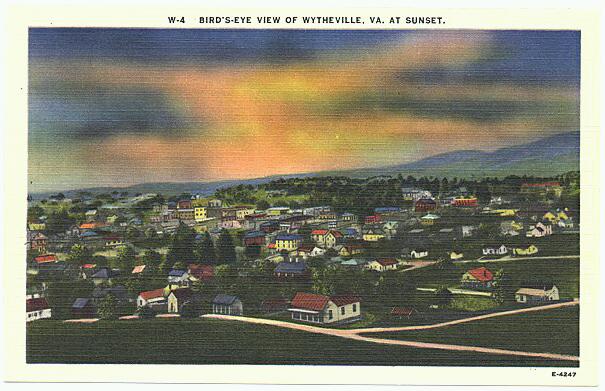
My great-great-grandfather Owens built this hotel in Wytheville, and my dad lived in the house behind it. Now there's a Stellar One bank there. More old postcards here.
8/16/2011
Hymn
A. R. Ammons
I know if I find you I will have to leave the earth
and go on out
over the sea marshes and the brant in bays
and over the hills of tall hickory
and over the crater lakes and canyons
and on up through the spheres of diminishing air
past the blackset noctilucent clouds
where one wants to stop and look
way past all the light diffusions and bombardments
up farther than the loss of sight
into the unseasonal undifferentiated empty stark
And I know if I find you I will have to stay with the earth
inspecting with thin tools and ground eyes
trusting the microvilli sporangia and simplest
coelenterates
and praying for a nerve cell
with all the soul of my chemical reactions
and going right on down where the eye sees only traces
You are everywhere partial and entire
You are on the inside of everything and on the outside
I walk down the path down the hill where the sweetgum
has begun to ooze spring sap at the cut
and I see how the bark cracks and winds like no other bark
chasmal to my ant-soul running up and down
and if I find you I must go out deep into your
far resolutions
and if I find you I must stay here with the separate leaves
A. R. Ammons
I know if I find you I will have to leave the earth
and go on out
over the sea marshes and the brant in bays
and over the hills of tall hickory
and over the crater lakes and canyons
and on up through the spheres of diminishing air
past the blackset noctilucent clouds
where one wants to stop and look
way past all the light diffusions and bombardments
up farther than the loss of sight
into the unseasonal undifferentiated empty stark
And I know if I find you I will have to stay with the earth
inspecting with thin tools and ground eyes
trusting the microvilli sporangia and simplest
coelenterates
and praying for a nerve cell
with all the soul of my chemical reactions
and going right on down where the eye sees only traces
You are everywhere partial and entire
You are on the inside of everything and on the outside
I walk down the path down the hill where the sweetgum
has begun to ooze spring sap at the cut
and I see how the bark cracks and winds like no other bark
chasmal to my ant-soul running up and down
and if I find you I must go out deep into your
far resolutions
and if I find you I must stay here with the separate leaves
7/17/2011
Chris Verene, My Twin Cousin's Husband's Brother's Cousin's Cousins, 2003
Chris Verene, Mercedes Will Soon Have a Half-Sister Named Lexus, 2005
Chris Verene, The Same Day They Signed the Divorce Papers a Tornado Hit the House, 2007
Chris Verene, Rosie Meeting Elanor and Doris, 2001
Chris Verene has been making documentary photographs about his family's rural Illinois hometown of Galesburg for the past two decades. There's an interview here.
Edit: I got to see his book at Look3 in 2013, and it was the funniest, most heartbreaking, most full-of-ordinary-life photo book I've ever held in my hands.
7/01/2011
Got curious about where Reed Creek starts. These are as close as I could get to the sources of its tributaries by following it on Google Maps. Get to a certain point and you can't tell the difference between a stream and a trail, or a change in elevation, or the shadows of trees. Guess there's only two ways to find out where the real headwaters are...!
And here's where it empties into New River:
6/13/2011
The City Limits
A. R. Ammons
When you consider the radiance, that it does not withhold
itself but pours its abundance without selection into every
nook and cranny not overhung or hidden; when you consider
that birds' bones make no awful noise against the light but
lie low in the light as in a high testimony; when you consider
the radiance, that it will look into the guiltiest
swervings of the weaving heart and bear itself upon them,
not flinching into disguise or darkening; when you consider
the abundance of such resource as illuminates the glow-blue
bodies and gold-skeined wings of flies swarming the dumped
guts of a natural slaughter or the coil of shit and in no
way winces from its storms of generosity; when you consider
that air or vacuum, snow or shale, squid or wolf, rose or lichen,
each is accepted into as much light as it will take, then
the heart moves roomier, the man stands and looks about, the
leaf does not increase itself above the grass, and the dark
work of the deepest cells is of a tune with May bushes
and fear lit by the breadth of such calmly turns to praise.
A. R. Ammons
When you consider the radiance, that it does not withhold
itself but pours its abundance without selection into every
nook and cranny not overhung or hidden; when you consider
that birds' bones make no awful noise against the light but
lie low in the light as in a high testimony; when you consider
the radiance, that it will look into the guiltiest
swervings of the weaving heart and bear itself upon them,
not flinching into disguise or darkening; when you consider
the abundance of such resource as illuminates the glow-blue
bodies and gold-skeined wings of flies swarming the dumped
guts of a natural slaughter or the coil of shit and in no
way winces from its storms of generosity; when you consider
that air or vacuum, snow or shale, squid or wolf, rose or lichen,
each is accepted into as much light as it will take, then
the heart moves roomier, the man stands and looks about, the
leaf does not increase itself above the grass, and the dark
work of the deepest cells is of a tune with May bushes
and fear lit by the breadth of such calmly turns to praise.
"Though these essays were written for a variety of occasions, they have a recurring subject – the effort we all make, photographers and nonphotographers, to affirm life without lying about it. And then to behave in accord with our vision."
From the foreword of Robert Adams' book Why People Photograph.
Subscribe to:
Posts (Atom)